Advanced Water Purification: What communities need to know about this water treatment process
Four key questions about water reuse and recycling and what Advanced Water Purification means for short and long-term growth across the American West.


Advanced Water Purification (AWP), also known as Advanced Water Treatment, is quickly becoming a cornerstone solution to water supply shortages, drought conditions, and continued uncertainty surrounding the Colorado River. With the ability to treat and reuse water locally for potable and non-potable applications, AWP can strengthen water resilience across the American West. As interest grows, so have questions from the general public: what is it, how does it help the community, and is it safe?
#1: How can water be reused, and why is it important within a community?
Because Earth’s water supply is finite and continuously cycles through natural and engineered systems, all water is reused in some form over time. Reusing water through engineered systems involves recycling existing sources of water and treating it for its end use, such as irrigation, industrial processes, or drinking water. To help sustain economic growth, communities are best served when they rely on local water resources, which can continue to be replenished and reused through recycling methods such as Advanced Water Purification. As many communities continue to grow across the Southwest, limits in local water supplies are challenging economic and residential development and pushing local decision-makers to consider new approaches to water management. For example, the Greater Phoenix area has historically relied significantly on water from the Colorado River. Now, record low snowfall across the American West in previous years has created continued drought conditions, which has downstream effects, such as drastically declining water levels in local reservoirs. In response, the region has collectively worked to invest in innovative approaches to bolster Arizona water supplies, including the use of Advanced Water Treatment technologies.
One of the most common misconceptions is that reusing or recycling water is a new practice, when many daily operations, such as farming or industrial cooling, already make use of recycled water. In fact, recycled water has been used for agricultural and irrigation purposes for thousands of years through the natural water cycle and for potable reuse (drinking water purposes) in the U.S. for over 50 years. Indirect potable reuse methods involve sending treated water to a reservoir or what's known as an environmental buffer, which then acts as an additional source of purification.
As communities look to strengthen local water supplies, they are increasingly turning to add Advanced Water Purification into their water treatment portfolio. By building upon a long history of water recycling with proven treatment technologies, AWP enables communities to expand existing reuse practices into a resilient, sustainable source of drinking water.
#2: Is the water truly safe to drink? How can I trust the quality?
As nationwide concern grows over the presence of hard-to-remove chemicals in drinking water sources, natural concern has risen about the quality of drinking water and the technology in use. When considering AWP technology specifically — per the U.S. Environmental Protection Agency (EPA), the drinking water produced from this technology meets or exceeds all Federal and State drinking water regulations. In fact, the finished water produced is often so pure that minerals are added back in for a more traditional taste.
More specifically, pharmaceuticals and personal care products (PPCPs) or Per- and Polyfluoroalkyl substances (PFAS) are more commonly being traced within local drinking water supplies, causing concern among local municipalities and water authorities. With these contaminants on the rise, AWP is being leveraged as a solution that can purify water in ways that previous technology couldn’t. So, not only does this process increase the resiliency of the drinking water supply within a community, but it can also protect us from emerging contaminants.
#3: How does Advanced Water Purification work?
Advanced Water Purification relies on three major treatment steps following conventional wastewater treatment to yield potable water. The additional treatment technology, as described below, removes remaining contaminants at the molecular level:
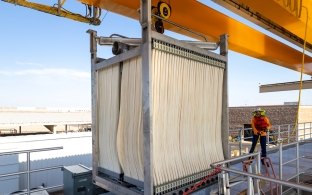
- Membrane Filtration is used to facilitate the tightest filtration possible. This helps to remove suspended solids, contaminants, and microorganisms, such as Giardia and some viruses.
- Reverse Osmosis (RO) forces water through a semi-permeable membrane that concentrates salts on one side and produces pure water on the other, removing dissolved solids and chemical constituents such as PFAS, PPCPs and many emerging contaminants of concern.
- Ultraviolet Light and Advanced Oxidation (UV/AOP) kills off any trace contaminants, similar to how sunlight can degrade materials over time through ultraviolet radiation.
#4: How does Advanced Water Purification serve me and my community?
Like its residents, municipalities are concerned with both the short-term and long-term effects of their water resource management plan and the impact on safety and availability for the community and local industry. While short-term effects, such as rising water rates and conservation mandates may seem like daily inconveniences, the nation’s ability to sustain its water supplies now has many long-term benefits. Residential development, the rise of domestic manufacturing, agriculture and many other key economic drivers pose risks to the coming generations of Americans who will measure growth potential by water availability.
In 2015, Orange County Water District (OCWD), which serves almost 2.5 million people, celebrated new infrastructure that would expand Orange County's ability to drastically combat the region’s drought conditions. The OCWD Groundwater Replenishment System (GWRS) expanded from 70 MGD to 100 million gallons per day (MGD), demonstrating the growing role of AWP as it continues to serve as a large-scale water supply solution. This facility has drastically changed Southern California’s water landscape, providing a significant reduction in the need for imported water from the Colorado River Basin and Northern California. A community once almost entirely reliant upon the Colorado River and other imported sources of water can now sustain 85% of its own water supply entirely within the region.
While recycling water may not be a new concept, rapidly evolving Advanced Water Treatment is emerging as an important tool to address water supply constraints and create long-term water resilience. The AWP technology not only increases the efficiency and quality of conventional treatment methods, but it also helps communities diversify their water treatment portfolio and therefore water resources to reduce reliance on imported water. Understanding how AWP works and why it matters helps communities make informed decisions about a water future that is already taking shape.