Opening Doors: How Mentorship Builds the Future of Construction
Mentorship opens doors to careers in construction by helping people build skills, confidence and connections while strengthening the industry for the future.
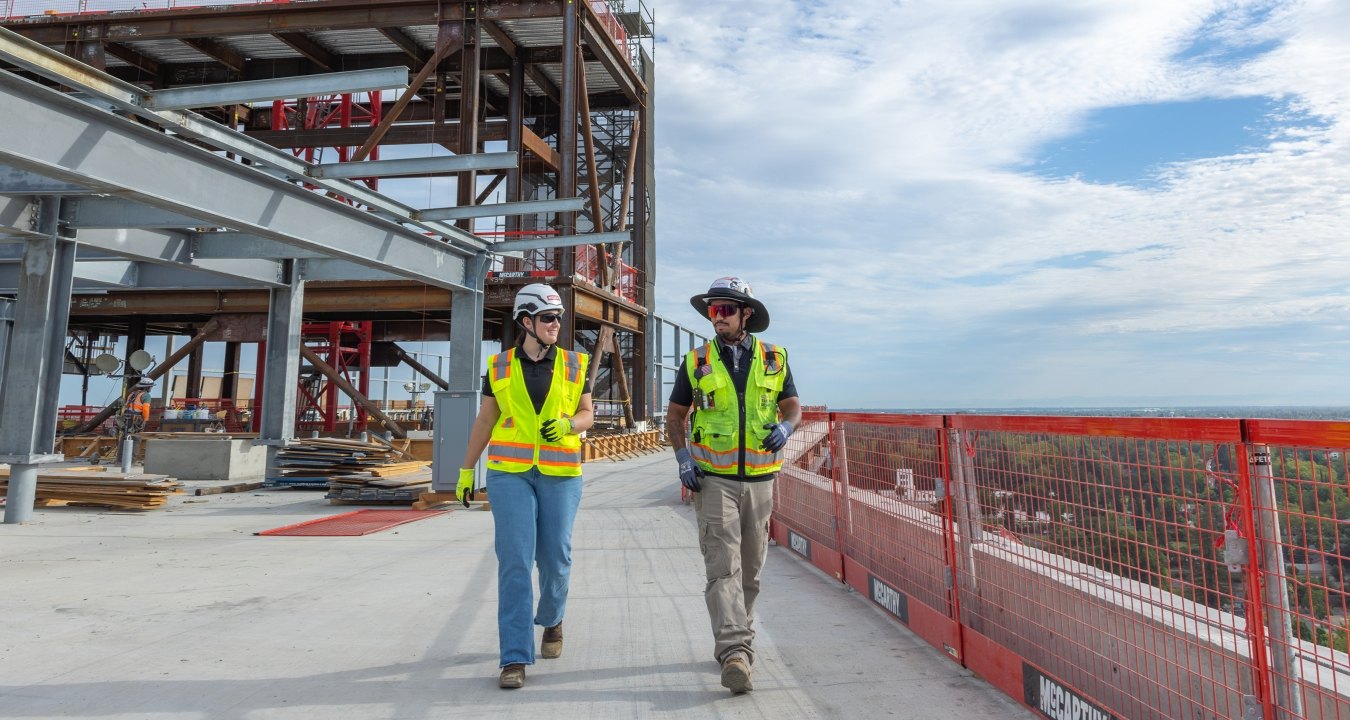
A career in construction can begin with a question: what will it take to for me to build a future in this industry?
For a student learning about construction, the answer may start with a teacher who explains the roles on a jobsite. For an apprentice, it may come from a craft professional who takes time to demonstrate a new skill. For someone considering a career change, it may be a conversation with a project leader who explains the many paths available across the industry.
Often, the first step is a person willing to open a door.
Construction Inclusion Week, taking place Oct. 12–16, 2026, focuses on “Opening Doors, Building a Workplace for Everyone.” One way to bring that theme to life is through mentorship: helping people see themselves in construction, understand how they can contribute, and then gain the confidence to take their next step. Mentorship, internships and apprenticeships are hands-on ways to empower growth and help people advance throughout their careers.
Mentorship strengthens people — and the industry
Mentorship is sometimes described as a transfer of knowledge from one generation to the next. It is that, but it is also more.
A mentor can help someone build technical skills, navigate an unfamiliar environment and connect classroom learning to real-world work. Mentors can share the lessons that are difficult to learn from a textbook: how to approach a problem, communicate with a team, ask for help, recover from a setback or recognize an opportunity.
The value goes both ways. When experienced professionals teach, explain and encourage, they strengthen their own leadership and communication skills. They also gain fresh perspectives from people who are newer to the team, the industry or the technology shaping construction’s future. Mentorship is not a one-way exchange; it is a way for teams to learn together.
A successful mentor/mentee relationship does not have to begin with a formal program. It can happen during a daily check-in, a jobsite walk, a lunch-and-learn or a conversation about career goals. A mentor might answer a question, provide feedback, introduce someone to a colleague or encourage them to pursue an opportunity they had not considered.
Those small actions can have a lasting effect. They help people build confidence and professional networks while strengthening, recruitment, engagement, retention and career development across the industry.
Opening doors starts early
For many people, construction is not a career they encounter through a traditional recruiting experience. They may not know what a project manager does, how a skilled trade connects to design or technology, or how many different roles contribute to a successful project. Outreach helps make those possibilities visible.
McCarthy teams engage students through school partnerships, classroom presentations, career fairs, site visits and hands-on learning events. These experiences introduce students to career paths ranging from skilled trades to project management and other related construction fields, while giving them opportunities to ask questions of people working in the field.
The ACE Mentor Program is one example of this engagement. Through ACE, McCarthy partners with high school students interested in architecture, construction and engineering. In Arizona, McCarthy has partnered with the ACE Mentor program at Phoenix Union’s Metro Tech High School for nearly a decade, providing industry lessons and mentorship to students in the school’s construction and electrical programs.
That relationship became especially meaningful as McCarthy worked on improvements at the school’s campus. Students had the opportunity to connect what they were learning through ACE with a construction project happening around them. For Art Aguilar, a McCarthy preconstruction director and ACE mentor, the experience demonstrated the power of seeing lessons unfold in real time. “It’s one thing to learn about construction within a classroom,” Aguilar said, “but seeing those lessons unfold in real time is what truly inspires students to pursue it as a career.”
The same principle guides McCarthy’s STEMstruction, a hands-on learning event that introduces high school students to construction and the range of careers within it. Through sample projects and learning stations, students can explore elements of trades such as masonry, heavy equipment, electrical work and virtual design and construction. They also practice working with peers and mentors to complete a project safely and effectively.
Experiences like these can challenge outdated assumptions about construction careers. Students see that the industry needs people who are analytical, creative, collaborative and hands-on. They see technology alongside craftsmanship. They see that there is not one “construction person” or one path into the industry.
They also meet people who can answer the questions that make a career feel more approachable: What does a typical day look like? How do I get started? What training do I need? Where can this career lead?
That is where outreach and mentorship connect. An event may spark interest, but a mentor can help sustain it. A mentor can follow up after a career fair, invite a student to a jobsite tour, explain the next step in an apprenticeship or simply remain available when questions arise.
Everyone can open a door
Mentorship does not belong only to people with a certain title or number of years in the industry. Anyone with experience, insight or encouragement to offer can help someone else move forward.
During Construction Inclusion Week and beyond, consider an action you can take:
- Invite a student, apprentice or new employee into a conversation.
- Share a lesson you wish someone had taught you earlier.
- Volunteer at a career day, jobsite tour or hands-on learning event.
- Connect someone exploring construction with a person who can answer their questions.
- Advocate for an opportunity that could help someone grow.
One conversation may not seem like much. However, for the person on the other side of it, that conversation could make construction feel more accessible, more welcoming and ultimately more possible.
The future of construction will be shaped not only by the projects we build, but also by the people and opportunities we build along the way. By mentoring others and helping everyone see a place for themselves in the industry, we can open doors and strengthen construction for generations to come.