All In for Safety: Celebrating Safety Week Across the Country
From wastewater and solar to airports, hospitals and marine work, McCarthy Building Companies teams across the country are sharing how they recognize close calls, stop the job and celebrate the people who speak up for safety.
Nelson Wastewater Treatment Facility Improvements
Mission, Kansas
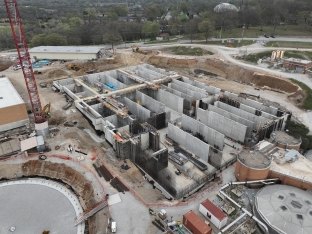
Built in the 1940s, the Nelson Wastewater Treatment Facility (WWTF) is Johnson County Wastewater’s oldest plant, and many components are at the end of their service life. McCarthy is now about 50% complete with replacement and upgrade work that introduces newer technologies, expands future wet-weather treatment capacity, and is being delivered while JCW continues full wastewater operations on site, requiring careful logistics, communication, and problem solving. The new Nelson WWTF will treat 15 million gallons per day (MGD), provide wet-weather capacity of 104 MGD, and feature 5-stage biological nutrient removal (BNR), disk filters, UV treatment, and full Class B biosolids processing.
What has the team done to make safety so successful on this project?
Strong communication has been central to our success and we use a variety of tools to improve planning, coordination and logistics. We’ve recently been exploring AI agents to support planning around high-risk schedule activities and to assist with safety meeting preparation based on current project trends and broader business unit insights.
Everyone on a McCarthy jobsite has both the right and the obligation to stop unsafe work. What has your team done to make sure that people feel confident enough to stop the job - and that they are celebrated for it?
For us, it starts with human connection — making sure our craft professionals feel respected, supported and part of the team. When people know we genuinely care about them, they are more likely to speak up and help create a safe, productive work environment. We make sure that the stop-work authority feels normal, expected, and fully supported.
Phoenix Sky Harbor Terminal 3 North Concourse
Phoenix, Arizona
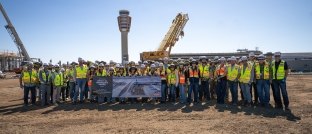
McCarthy is constructing a new multi-level concourse at Phoenix Sky Harbor International Airport. It features a pedestrian bridge connecting Terminal 3 to the new North Concourse along with six new gates, holdrooms and retail and concession space to enhance the traveler experience.
The team is also delivering several enabling projects across the airport, including Cargo D warehouse space, new South Gates holdrooms, relocation of an existing Starbucks and mechanical upgrades at the Central Utility Plant.
What has the team done to make safety so successful on this project?
From day one, establishing and maintaining a strong safety culture has been a top priority for the project team. We have created an environment where all personnel feel empowered to speak up, report concerns and help keep the jobsite safe. Open communication, consistent engagement and clear expectations have made the Stop Work Authority a normal and supported part of our culture. This proactive approach has helped prevent incidents, strengthen accountability and improve planning for high-risk activities. We are also using a new AI agent to support safety moments and analyze jobsite trends.
Can you describe a moment on your project where your team recognized a close call and asked hard questions or had hard conversations? What did it change?
Early in the project, the team experienced a significant near miss that led us to closely evaluate our processes and controls. With so many inspectors working on-site, often with limited visibility to nearby vehicles and equipment, we knew we needed a better way to create clear visual reminders before moving vehicles.
That conversation led to meaningful changes, including 360-degree walk-around “top hats” for vehicles and flagged stanchions that inspectors place near their work areas. Together, these measures reinforce full walk-around inspections prior to vehicle movement and increase visibility for ground-level work. The result has been stronger situational awareness and a reduced risk of struck-by incidents and property damage.
UC Davis Health California Tower
Sacramento, California
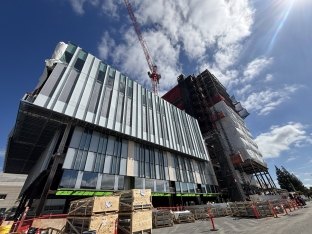
UC Davis Health California Tower is a 14-story, approximately 1 million-square-foot healthcare facility in Sacramento that will add 334 private patient rooms to enhance recovery and healing. The tower will create 238 ICU rooms and help meet the region’s healthcare needs for the next 50 years. The project will also include new operating rooms, an imaging center and new facilities for existing pharmacy and burn care units.
What has the team done to make safety so successful on this project?
Safety at the California Tower has thrived through a strong, unified culture that reflects McCarthy, our trade partners and our clients’ commitment to being all in. Our safety professionals consistently demonstrate genuine care for everyone who enters the site - and that mindset has carried through to the entire workforce. Through strong collaboration between our craft and office teams, we’ve created a safe, open environment where people feel comfortable raising questions and concerns, knowing every issue is taken seriously and addressed.
Can you describe a moment on your project where your team recognized a close call and asked hard questions or had hard conversations? What did it change?
We experienced a serious near miss when a trade partner was hoisting angle iron to an upper floor and several pieces fell from about 100 feet. The noise alerted workers below, giving them just enough time to move. Several individuals were only inches from serious injury.
After the incident, craft professionals and managers came together to investigate what went wrong and identify how to prevent it from happening again. The next day, we held a project-wide Safety Stand Down to review the event and reinforce key safety practices. That transparency helped strengthen our safety culture by encouraging open discussion, shared learning and a proactive approach to keeping everyone safe.
Spilman Island
La Porte, TX
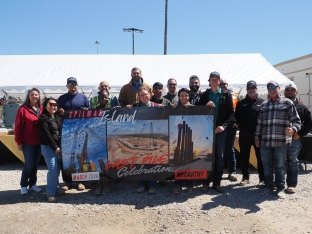
The Spilman Island project is a U.S. Army Corps of Engineers marine project to improve navigation and strengthen shoreline protection along parts of the Houston Ship Channel. The team is removing old marine structures, building new bulkhead walls, relocating and rebuilding berms, and performing major dredging work in Barbours Cut Channel and Cedar Bayou.
Can you describe a moment on your project where your team recognized a close call and asked hard questions or had hard conversations? What did it change?
During the project, our team experienced a close call during a routine sheet pile driving operation that had the potential for serious consequences. While no one was injured, it prompted us to stop and reassess. We used the incident to ask hard questions about planning, execution and how risks were being communicated in the field.
In response, we strengthened our Activity Hazard Analyses, increased focus on stored energy hazards and reinforced clearly defined exclusion zones. Most importantly, it reinforced a culture where stopping work, speaking up and questioning the plan are expected, helping the team move from simply following processes to truly owning the risks.
Everyone on a McCarthy jobsite has both the right and the obligation to stop unsafe work. What has your team done to make sure people feel confident enough to stop the job, and that they are celebrated for it?
From day one, we set the expectation that stopping work is both a right and a responsibility. That message starts in project safety orientation and is reinforced by leadership and operations throughout the project.
Through regular field engagement and weekly toolbox talks, crews are encouraged to share examples of taking pride in safety, including times when someone stopped work to reassess a task or address a hazard. Those actions are recognized and celebrated as doing the right thing, not creating blame, which has helped build a culture where people feel confident stepping in with the full support of the team.
SSM Health Cardinal Glennon Children's Hospital
St. Louis, Missouri
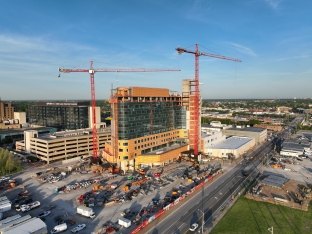
This new, 14-story hospital will replace and upgrade the existing SSM Health Cardinal Glennon Children’s Hospital.
What has the team done to make safety so successful on this project?
Safety has been most successful on this project when high-risk tasks are planned and managed by the full team, not just a safety manager or a small group. Early in the project, site staff spent significant time on the ground aligning around site expectations, culture and overall approach. Those expectations have remained consistent for the past two years, and that consistency has been at the heart of nearly every safety success on the project. In short, the difference has been team collaboration and consistency.
Can you describe a moment on your project where your team recognized a close call and asked hard questions or had hard conversations? What did it change?
After a dropped object incident, our entire staff recognized the seriousness of the close call. It pushed the team to ask hard questions and have honest conversations about what happened and what needed to improve in our falling object protection plans.
Those discussions led to a strengthened site-specific permitting process designed to better stagger crews and prevent work from taking place directly overhead of another team. Managing that process requires strong collaboration, daily planning and communication, and consistent follow-through.
Buffalo Solar
Morris, Illinois
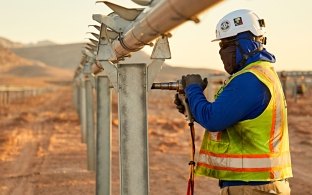
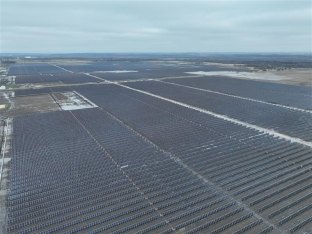
The Buffalo Solar Project is a 116 MW/AC utility-scale photovoltaic facility delivering renewable energy to the grid. Work includes full-site civil development, mechanical installation of post foundations, racking systems and modules.
Can you describe a moment on your project where your team recognized a close call and asked hard questions or had hard conversations? What did it change?
We had a moment on-site that caused us to stop work and take a closer look at one of our standard practices. On solar projects, front-end loaders are used often to offload and move torque tubes from the truck to the field. After a close call, our team asked hard questions and realized the equipment did not have the capacity to safely handle the torque tubes the way they were being offloaded.
Additional research confirmed that the actual capacity shown on the load chart is 40% lower when forks are used instead of a bucket. That finding led to a meaningful change: front-end loaders will generally no longer be used to offload torque tubes on solar projects.
Everyone on a McCarthy jobsite has both the right and the obligation to stop unsafe work. What has your team done to make sure people feel confident enough to stop the job, and that they are celebrated for it?
Stop Work Authority is reinforced in toolbox talks and during safety stand-downs following an incident. It's also recognized and celebrated through shoutouts at our weekly all-hands meetings, with workers who use their authority being rewarded with exclusive swag items like high-vis shirts.
Across every market and jobsite, one theme is clear: safety is strongest when teams create a culture where speaking up is expected, stopping work is supported and close calls become opportunities to learn and improve. These stories show that when people lead with care, communicate openly and act on what they learn, safety becomes more than a program; it becomes part of how the work gets done every day.